A professional dry cleaning is same-day work. We arrive, we clean, and you walk on the carpet before we have finished loading the van. What decides whether it still looks that way in week six is not the cleaning — it is the six weeks.
This is the routine we give our own customers in Raleigh, Durham, Cary and Chapel Hill. It is written for North Carolina dirt specifically, because the thing that ruins carpet here is not the same thing that ruins it in Denver or Phoenix. Follow it and you will get more out of every cleaning you pay for, and your carpet will last longer between replacements.
Why Raleigh is harder on carpet than most places
Three local conditions do most of the damage, and only one of them is obvious.
Red clay is a dye, not a dirt
Piedmont clay is loaded with iron oxide. That is what makes it red, and it is also what makes it behave unlike ordinary soil. Sand and grit sit on top of a fiber and can be vacuumed off. Clay particles are far finer and they carry pigment, so when they meet a damp carpet fiber they do not sit on it — they bond to it.
This has three consequences most homeowners learn the hard way:
- Scrubbing sets it. Working a clay spot with a cloth drives pigment deeper into the pile and frays the fiber tips, which then hold more of it.
- Water makes it worse, not better. Wetting a clay stain spreads the pigment through the pile and down into the backing, where you cannot reach it.
- It comes back. Clay driven into the backing wicks upward as the carpet dries, which is why a spot you “removed” reappears two days later, slightly larger.
Most of it arrives on shoes. It takes roughly seventeen steps on an indoor surface before the soles of your shoes stop depositing what they picked up outside — which means an entryway mat and a no-shoes habit stop more clay than any product does.
Spring pollen loads the carpet like a filter
From late March into May, the Triangle coats everything in yellow-green pine pollen, and the fine particles you cannot see are the ones that settle into carpet. Your carpet is the largest filter in the house, and during those weeks it keeps loading whether or not anyone walks on it.
The answer is frequency, not a different method. Vacuum more often through pollen season and keep windows shut on heavy days. Nothing else about the routine needs to change.
Humidity narrows your margin for error
North Carolina summers are humid, and a humid house dries slowly. That matters because every wet cleaning method — hot water extraction, shampoo, a rental machine — leaves moisture in the pile and the backing that has to go somewhere. In a dry climate it evaporates. Here it lingers, and damp carpet backing is where musty odors start.
It is the same reason our own service uses no water. A low-moisture method has no drying window to get wrong, which is the whole point in August.
The routine, by how often you do it
| How often | What to do |
| Daily, high-traffic lanes | A few slow vacuum passes on entryways and hallways |
| Weekly | Full room. 4–6 passes in traffic lanes, 2–3 elsewhere |
| The moment it happens | Blot spills. Never rub. Work from the outside in |
| Monthly | Dry powder through traffic lanes and any spots |
| Every 6 months | Move the furniture |
| Every 6–12 months | Professional cleaning. Every 3–6 with pets |
Vacuuming, done properly
Buying a good vacuum is not the same as using it well, and most people undo their own effort in small ways:
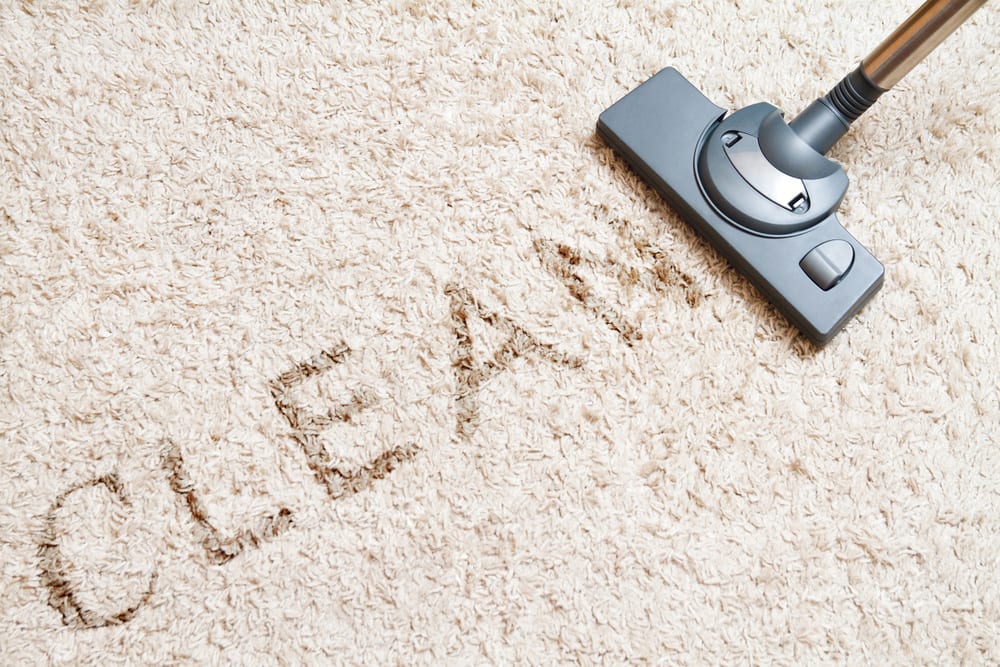
- Go slowly. This is the single most common mistake. A slow pass lets the beater bar vibrate the pile and gives the airflow time to lift what comes loose. A fast pass mostly moves the head around.
- Keep the bag under half full. Suction falls off long before a bag looks full.
- Check the belt and the brushes. A slack belt or a brush roll wound with hair is doing almost nothing, and you will not hear the difference.
- Set the head height to the pile. Too low damages fiber tips, too high loses contact entirely. And if you are wondering whether vacuuming is enough on its own, it is not — it is the half of the job you can do yourself.
- Do not run the vacuum over a snag. Clip the loose fiber off at the base with scissors instead. Pulling it unravels the row.
Wear and tear you can prevent
Mats at every entrance, a no-shoes habit indoors, pads or coasters under heavy furniture legs, and furniture moved a few inches twice a year so the same fibers are not permanently crushed. Blinds or curtains drawn during peak sun on south-facing rooms, because UV fades carpet and weakens fiber over years. Carpet protection sprays are worth understanding too — what they do, and when they wear off.
If you have animals, add one more step. Pet hair twists down into the pile and a vacuum alone will not always bring it back out, so work a rubber-edged tool or a pet attachment across traffic areas first and vacuum afterwards. Hair left in the pile traps odor and holds the fine grit that wears fiber down.
None of this is dramatic, and that is rather the point. Carpet cleaned by hot water extraction gets replaced at around seven years on average. Most of the distance between that and a carpet that is still worth keeping comes from the unglamorous parts of the list above.
Spills, and the one case where the usual advice is wrong
For almost everything — coffee, juice, wine, pet accidents — the rule is the same. Blot with a clean white cloth or paper towel, press rather than rub, work from the outside of the spot toward the middle so you are not spreading it, and test any cleaning product on an out-of-sight patch first. Do not soak the area. Do not reach for bleach or an ammonia-based cleaner, which strip color. There is also a household spot treatment that works on a surprising range of spills, if you would rather not buy anything.
Red clay is the exception, and it is worth knowing before it happens.
Let clay dry before you touch it. A wet clay spot is pigment suspended in water, and anything you do to it moves that pigment somewhere you do not want it. Wait until it is fully dry, break up the crust gently, vacuum the solids away, and then treat what is left dry. Reaching for a wet cloth first is the instinct, and it is how a small clay spot becomes a permanent shadow in the backing.
Where a dry powder fits
Between professional cleanings, the useful tool is a dry cleaning powder. We make our own — Spotless dry carpet cleaning snow — and it is the same compound our technicians carry, sold by the bag for customers who want to keep things fresh between visits.
It is a cellulose micro-sponge carrying a mild organic solvent and natural surfactants, at a pH of 7.5, which makes it safe across wool through synthetic blends. You sprinkle it over the carpet, brush it into the pile, leave it 30 to 45 minutes while the sponges absorb what they have dissolved, and vacuum it out. Each sponge holds about ten times its own weight.
What makes it worth using here specifically: there is no water in it. Nothing soaks, nothing has to dry, and the carpet is walkable throughout — which in a humid North Carolina summer removes the main risk of doing anything to your carpet yourself. It also leaves no detergent behind, so it does not create the sticky residue that makes a carpet re-soil faster than it did before.
Used monthly on traffic lanes, it keeps a professional cleaning looking recent for considerably longer. Here is how to use it on a single spill rather than a whole room.
What it is not: a deep clean. A powder works at the surface and the upper pile. It does not reach ground-in soil at the base of the fiber or anything that has made it into the backing, and it will not lift a stain that has already set. That is a different job, with different equipment.
When to stop maintaining and book the cleaning
Maintenance extends a cleaning. It does not replace one. Call us when you have any of these:
- Traffic lanes that stay gray after vacuuming. That is soil at the base of the fiber, below where a vacuum or a powder reaches.
- A stain that has set, or one that keeps reappearing after you have treated it — wicking from the backing is not a surface problem.
- Pet urine that has reached the padding. Surface treatment will not touch it, and the odor will keep coming back until the source is dealt with. That is its own service.
- Ground-in red clay that survived a dry treatment.
- The calendar. Most carpet warranties require professional cleaning every 18 to 24 months to stay valid, and most households do better on a shorter cycle than that. How often you should schedule it depends on traffic and pets — 6 to 12 months for most homes, 3 to 6 with animals.
Our dry carpet cleaning service uses no water at all, so there is no drying time and no damp backing left behind. The carpet is walk-ready the moment we finish.
The short version
Vacuum slowly and often. Stop clay at the door, and let it dry before you touch it. Blot spills immediately and never rub. Run a dry powder through the traffic lanes monthly. Then book the professional cleaning on a schedule instead of waiting until the carpet looks bad — the whole point of the routine above is to make that cleaning last, not to replace it.
Ready to book, or want to see the process first? Call (919) 878-0748 for a free estimate. We will also clean the worst three-by-three-foot patch of carpet in your house for free, so you can see the result before you commit to anything.